 Chaingpt
 applies AI to crypto research, smart contract development, and NFT creation
Chaingpt is an artificial intelligence platform that combines crypto research, Solidity smart contract tools, and non-fungible token (NFT) creation. Its Crypto AI Hub includes a Web3 chatbot, market analysis, news, and alerts. The Smart Contract Generator turns natural-language requirements into code, while the auditor examines Solidity contracts for potential vulnerabilities. CGPT, the ecosystem's utility and governance token, connects paid access, staking benefits, and participation in platform governance.
Updated ·
Bottom line: Chaingpt combines conversational research with specialized creation tools, and generated contract code needs testing beyond successful compilation.
Research answers and generated code
The Web3 AI Chatbot answers crypto and blockchain questions through conversation, while specialized tools produce contract code, security findings, or artwork. Its research features cover technical reports, governance changes, and decentralized finance (DeFi). A conversational answer can explain a protocol concept; the contract tools address the executable rules behind blockchain applications. NFT generation extends the platform into visual creation.
The chatbot combines blockchain-focused knowledge with live-data research and market context. Its beta interface continues to evolve. An answer about a changing market or protocol setting carries a different time scope from an explanation of a durable technical concept.
The requirements behind Solidity generation
The Smart Contract Generator creates Solidity code from descriptions of intended functionality, using Solidity LLM, a language model specialized for smart contracts. Solidity expresses the rules that compatible blockchain environments execute. The generator also supplies contract summaries and explanations, plus compilation and deployment capabilities. Its deployment module targets supported Ethereum Virtual Machine (EVM) networks, which share an execution environment for this kind of code.
A prompt defines the intended behavior. A fluent explanation of the generated contract cannot fill requirements that the prompt never specified.
Permissions and operational rules therefore belong in the contract specification. Code that allows an administrator to change behavior differs materially from code with fixed rules. The accompanying explanation helps make those choices visible, while testing examines the code's actual behavior. Access to the web generator requires a connected wallet.
Contract development stages and security limits
A generated contract meets its intended purpose only when its behavior matches the stated requirements. The generator supplies code, explanations, compilation, and deployment; the auditor contributes vulnerability analysis. These capabilities support a development sequence in which code review and testing precede deployment.
| Development activity | Output and security limit |
|---|---|
| Describe the required behavior | The specification states intended rules; missing requirements can leave important behavior undefined. |
| Generate Solidity code | The generator supplies proposed code; its correctness needs behavioral testing. |
| Read the contract explanation | The summary describes the proposed logic; it needs to agree with the requirements. |
| Compile the contract | Compilation checks syntax and prepares bytecode; it does not establish secure behavior. |
| Review findings and test behavior | AI analysis identifies potential issues; testing and code review assess the implementation before deployment. |
| Deploy the reviewed, compiled contract | The deployment module publishes code to a supported network; deployment does not resolve undiscovered vulnerabilities. |
| Generation, compilation, auditing, and deployment provide different kinds of evidence about a contract. | |
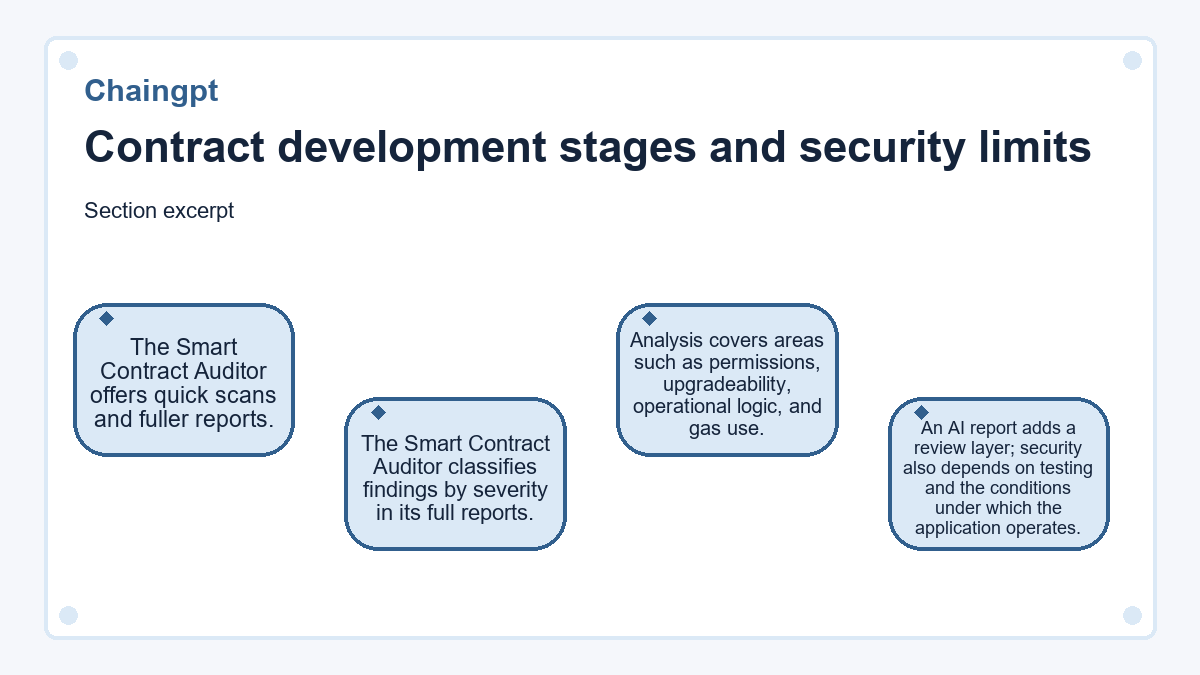
The Smart Contract Auditor offers quick scans and fuller reports. The Smart Contract Auditor classifies findings by severity in its full reports. Analysis covers areas such as permissions, upgradeability, operational logic, and gas use. An AI report adds a review layer; security also depends on testing and the conditions under which the application operates.
Artwork generation and on-chain minting
The AI NFT Generator creates artwork from prompts and supports minting on compatible networks. Image generation produces the visual material; minting creates the associated blockchain token. The application offers single-image and collection modes, with options for reference images, prompt refinement, and collection traits. A collection groups related artwork, while single-image generation gives attention to an individual output.
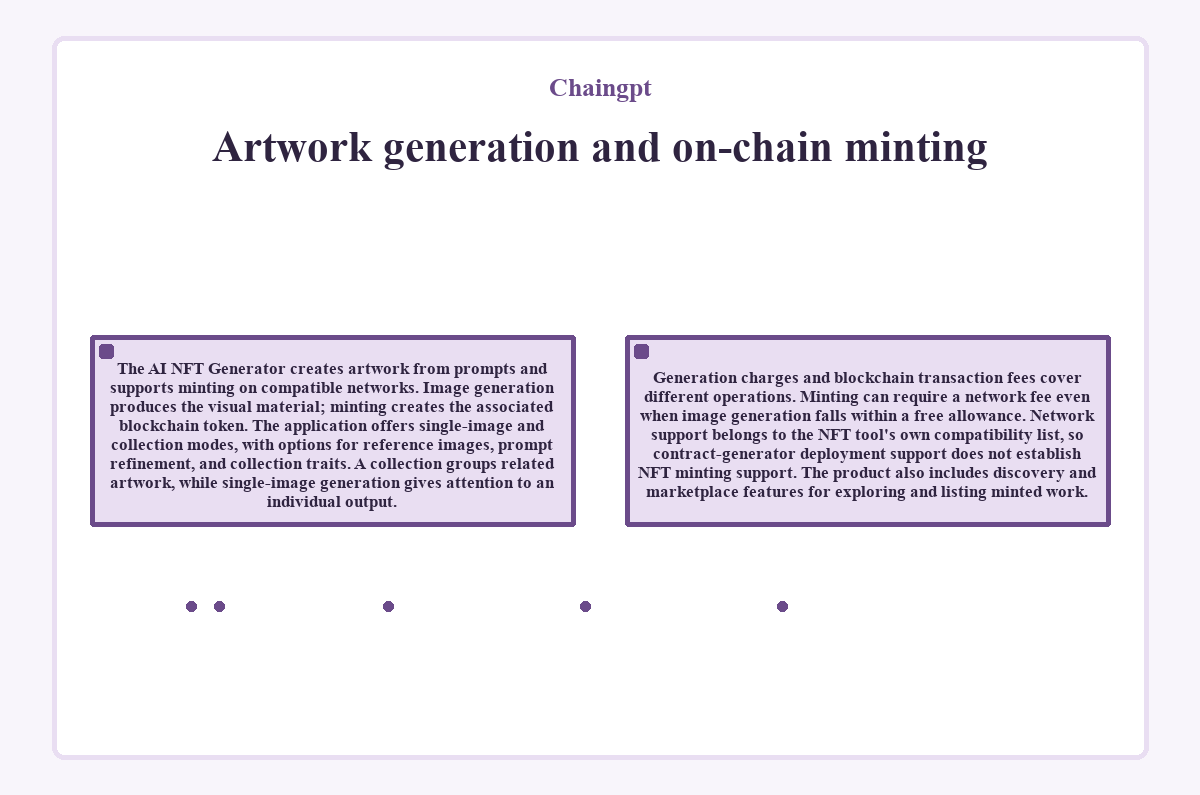
Generation charges and blockchain transaction fees cover different operations. Minting can require a network fee even when image generation falls within a free allowance. Network support belongs to the NFT tool's own compatibility list, so contract-generator deployment support does not establish NFT minting support. The product also includes discovery and marketplace features for exploring and listing minted work.
Market patterns, news, and alerts
The AI Trading Assistant analyzes historical price behavior and projects possible chart formations across supported assets. Its features include pattern detection, liquidation heatmaps, and market metrics. A historical pattern describes past price structure; a projected pattern estimates a possible future formation. Historical detection and predictive modeling have different asset coverage, so support in one mode does not establish availability in another.
AI Web3 News summarizes developments across crypto, blockchain, and AI. AI Crypto Alerts focuses that stream on selected tokens, projects, and relevant events.
News and alerts add event context to price analysis. The alert tool supports watchlists and places developments alongside price charts, while news summaries organize information from multiple inputs. These tools describe market activity and possible interpretations. A predicted formation remains a model output, even when nearby news or sentiment appears to support the same direction.
The credit model behind free and paid access
Free allowances provide limited access to selected AI tools, while Pay-Per-Prompt access charges for usage beyond the applicable allowance. Paid usage uses CGPT Credits, abbreviated CGPTc. Users can obtain credits without staking by paying with crypto or a card, or by converting CGPT. The platform defines one CGPTc as $0.01 of usage credit. This accounting unit differs from the CGPT token, whose market price can change. Converting CGPT into credits is irreversible; credits cannot be converted back into CGPT.
Charges follow the selected tool, request type, and enabled options. Conversation history can add a charge for applicable API requests. Web-app allowances and API billing have their own contexts, so a free web use does not establish an equivalent API entitlement. The Freemium plan gives qualifying Diamond-tier stakers a recurring premium credit allowance; tool calls still consume that allowance.
Token ownership and staking-based benefits
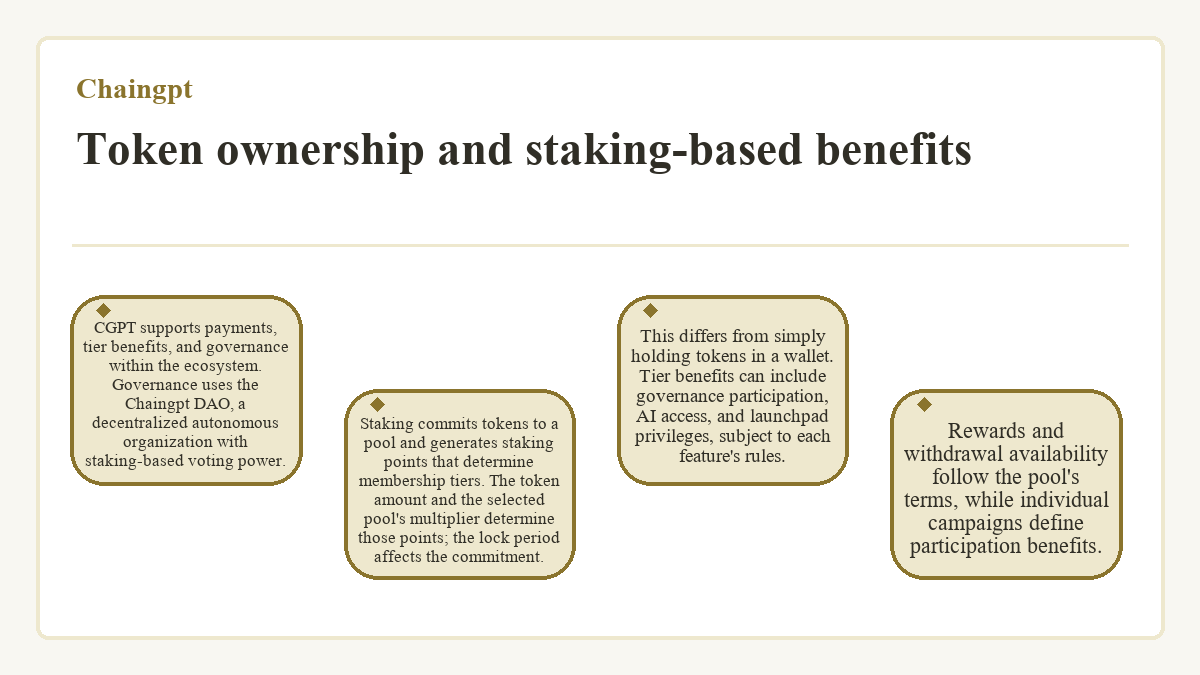
CGPT supports payments, tier benefits, and governance within the ecosystem. Governance uses the Chaingpt DAO, a decentralized autonomous organization with staking-based voting power. Staking commits tokens to a pool and generates staking points that determine membership tiers. The token amount and the selected pool's multiplier determine those points; the lock period affects the commitment. This differs from simply holding tokens in a wallet. Tier benefits can include governance participation, AI access, and launchpad privileges, subject to each feature's rules. Rewards and withdrawal availability follow the pool's terms, while individual campaigns define participation benefits.
The credentials behind integrations and agents
APIs and software development kits (SDKs) make the platform's AI functions available inside other applications. Integrations can use conversational responses, contract generation, auditing, NFT tools, and crypto news. An API connects an application to the service; an SDK supplies programming interfaces that simplify that connection. Tool-specific support, authentication, available credits, and request limits determine which integration can operate.
An API key authorizes service requests against an account. It belongs in a secure backend or secret store, away from public application code.
AgenticOS is an open-source framework for Web3 agents on X. It supports scheduled posts and updates from subscribed news categories. The framework connects the Chaingpt and X APIs, so operation requires a compatible runtime and credentials for both services.
Transaction screening and regulatory guidance
CryptoGuard adds browser-based analysis of websites, wallet activity, tokens, and transactions. Its live tracker can display risk alerts before confirmation, with coverage limited to supported networks. That screening differs from Cross-Chain Swap, which aggregates exchange routes for token swaps. The swap feature involves asset movement and wallet authorization, while a risk assessment describes potential threats. A warning-free assessment does not change the permissions that a transaction requests or establish protection against every attack.
The Crypto Compliance Assistant addresses regulatory questions using jurisdiction and entity context. Its subject areas include licensing, identity checks, anti-money-laundering obligations, taxation, and reporting. Those answers help explain requirements that apply to a particular activity. An AI response does not grant a license or an authority's approval, and a different jurisdiction or operating structure can change the applicable requirements.
Launchpad rules and longer-term AI infrastructure
Chaingpt Pad organizes token launches and related sales. Participation follows each sale's eligibility and allocation rules, which can include identity verification, regional restrictions, and staking tiers.
Chaingpt Labs supports AI and Web3 startups through investment and incubation. These activities concern project development and financing, alongside the platform's directly usable AI applications. Launchpad access, startup support, and an AI tool request each have their own conditions; a token holding does not create an entitlement to every ecosystem service.
AIVM, the AI Virtual Machine, is Chaingpt's blockchain initiative for AI-native applications and agent execution. The completed Q3-Q4 2025 roadmap includes an internal private testnet; the June 11, 2026 roadmap lists public-testnet development objectives. Its development direction includes decentralized model computation, training, and marketplaces for AI resources. The existing Crypto AI Hub provides access to applications; the blockchain initiative concerns the infrastructure on which AI systems could operate.
Questions and answers about Chaingpt
Can I use the chatbot through Telegram or Discord?
The Web3 AI Chatbot has Telegram and Discord integrations alongside web access. Community implementations can tailor the context of conversations, and their available features can differ from the web application. The NFT generator also has limited chat-based versions, so access through a messaging platform does not establish full web-tool functionality.
Can the generator create multiple contracts from one prompt?
The Smart Contract Generator supports multiple contracts from one prompt when the requested functionality needs them. Its explanations help describe the resulting code. Contracts that interact require review of their shared assumptions and permissions, because checking each file separately can miss problems in the combined application.
Does a full AI audit accept a private GitHub repository?
The Smart Contract Auditor supports full audits using both public and private GitHub repositories. A private repository requires authorization for the integration to read its code. Repository permissions determine access to the material that the service can analyze.
Which networks carry CGPT tokens?
CGPT has deployments on BNB Chain and Ethereum, plus a bridged representation on Solana. These token representations belong to different network contexts. Their existence does not define every network that the chatbot, NFT generator, or contract deployment tool supports, since each product has its own compatibility scope.
Should an AI prompt include a wallet recovery phrase?
A wallet recovery phrase should never appear in an AI prompt. It can give someone access to the wallet's private keys and funds. Crypto research and contract analysis need the relevant question or code, not recovery credentials. A public wallet address has a different purpose and does not reveal the recovery phrase.
What does a 429 response mean from the auditor API?
A 429 response indicates that requests have exceeded the auditor API's rate limit. Reducing request frequency or queuing work addresses that limit. Adding credits addresses a credit shortage, which is a separate condition. An integration should distinguish throttling from authentication errors and insufficient-credit responses.
How does AI Crypto Alerts describe sentiment?
AI Crypto Alerts classifies summarized developments as bullish, bearish, or neutral. It also derives a token bullishness score from aggregated sentiment and alert frequency. This measures the tool's interpretation of the alert stream; it does not express a verified probability that a token's price will rise.