 Chaingpt
Chaingpt generates NFT artwork as individual images or coordinated collections
Chaingpt's AI NFT Generator turns text descriptions into artwork for individual non-fungible tokens (NFTs) or collections. Single-image mode centers on a particular composition; collection mode creates variations around a shared concept. Prompts, model choices, styles, and optional reference images shape the visuals. Collection settings add trait distributions, while metadata and minting connect approved artwork to blockchain tokens. A shared style can connect a collection without making every image identical, which matters when choosing between a standalone piece and a coordinated series.
Updated ·
Trait ratios guide how often attributes appear across a collection, so individual images can differ while sharing an art style.
Prompts, models, and styles
The text prompt describes the desired artwork, the model generates the image, and the style setting guides its visual treatment. A description can identify the subject and its surroundings. Style adds an aesthetic direction, while model selection determines which generation system interprets those instructions. Similar descriptions can produce different-looking artwork when the model or style changes.
The in-house model options include VeloGen, NebulaForge XL, and VisionaryForge. Image dimensions and refinement settings also belong to the generation request, with supported values that vary by model. A style name does not establish which dimensions or refinement settings the model accepts.
The controls behind a shared visual theme
A shared prompt and style provide a common direction for collection artwork, while reference-image input supplies visual material that the generator can reinterpret. Descriptive text establishes what belongs in the image; a reference introduces an existing appearance into that request. The prompt enhancer offers another kind of assistance by refining or expanding the text before image generation. Choosing this assistance does not determine collection size or replace trait settings.
What changes when you choose a collection?
Collection mode changes the creative task from developing an individual composition to generating a related batch with shared settings and optional trait distributions. The web generator supports requests for up to 10,000 images in its Collection mode. The batch limit counts images; trait categories describe the differences among those images.
Traits describe attributes that distinguish items within the collection. The API accepts trait categories, possible values, and ratios that guide their occurrence. Those ratios describe the intended distribution across generated artwork. They do not promise an exact count for each value in every batch. Visual differences and relative frequency therefore answer different questions: what an item looks like, and how often a characteristic appears.
Rarity settings govern frequency; they do not establish a sale price.
Image dimensions and enhancement
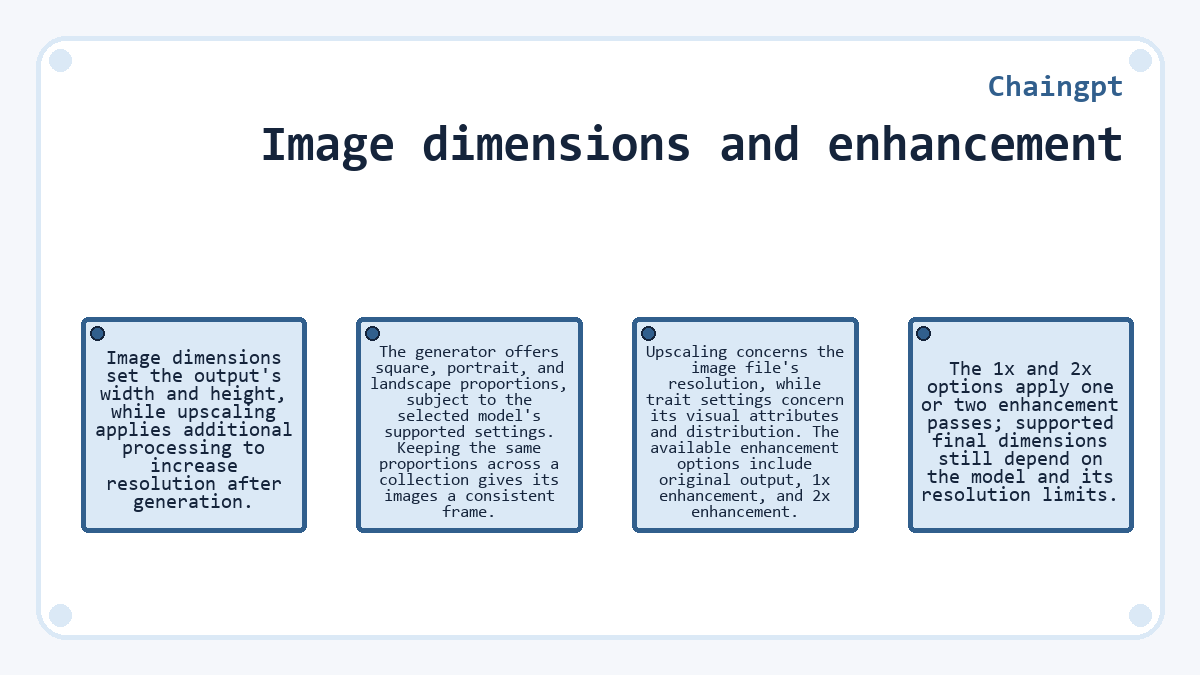
Image dimensions set the output's width and height, while upscaling applies additional processing to increase resolution after generation. The generator offers square, portrait, and landscape proportions, subject to the selected model's supported settings. Keeping the same proportions across a collection gives its images a consistent frame. Upscaling concerns the image file's resolution, while trait settings concern its visual attributes and distribution. The available enhancement options include original output, 1x enhancement, and 2x enhancement. The 1x and 2x options apply one or two enhancement passes; supported final dimensions still depend on the model and its resolution limits.
The credits behind a batch
Paid image generation uses service credits labeled CGPTc, with a base rate of 1 credit per image for the in-house models. The platform also offers daily free usage for single-image generation. Optional processing adds charges to paid requests, so the selected settings determine the applicable generation price.
Consider a hypothetical paid request for 42 collection images using a supported in-house model at its base generation settings. This request omits upscaling, paid prompt enhancement, character preservation, and any additional refinement surcharge.
At 1 CGPTc per base image, the generation charge is 42 × 1 = 42 CGPTc.
Additional images increase the base charge in proportion to their number, while optional processing changes the calculation. Blockchain minting fees fall outside this artwork-generation total.
From artwork files to NFT metadata
NFT metadata describes an artwork and connects its image file with information about the token. Names, descriptions, and attributes give a collection structure beyond its appearance. The generator supports metadata customization, so visual generation and descriptive information remain distinct parts of NFT creation.
Collection metadata makes individual items understandable within the series. A common visual theme can coexist with different item attributes. The description of an item should match its artwork; naming an attribute in metadata does not change the pixels in the image.
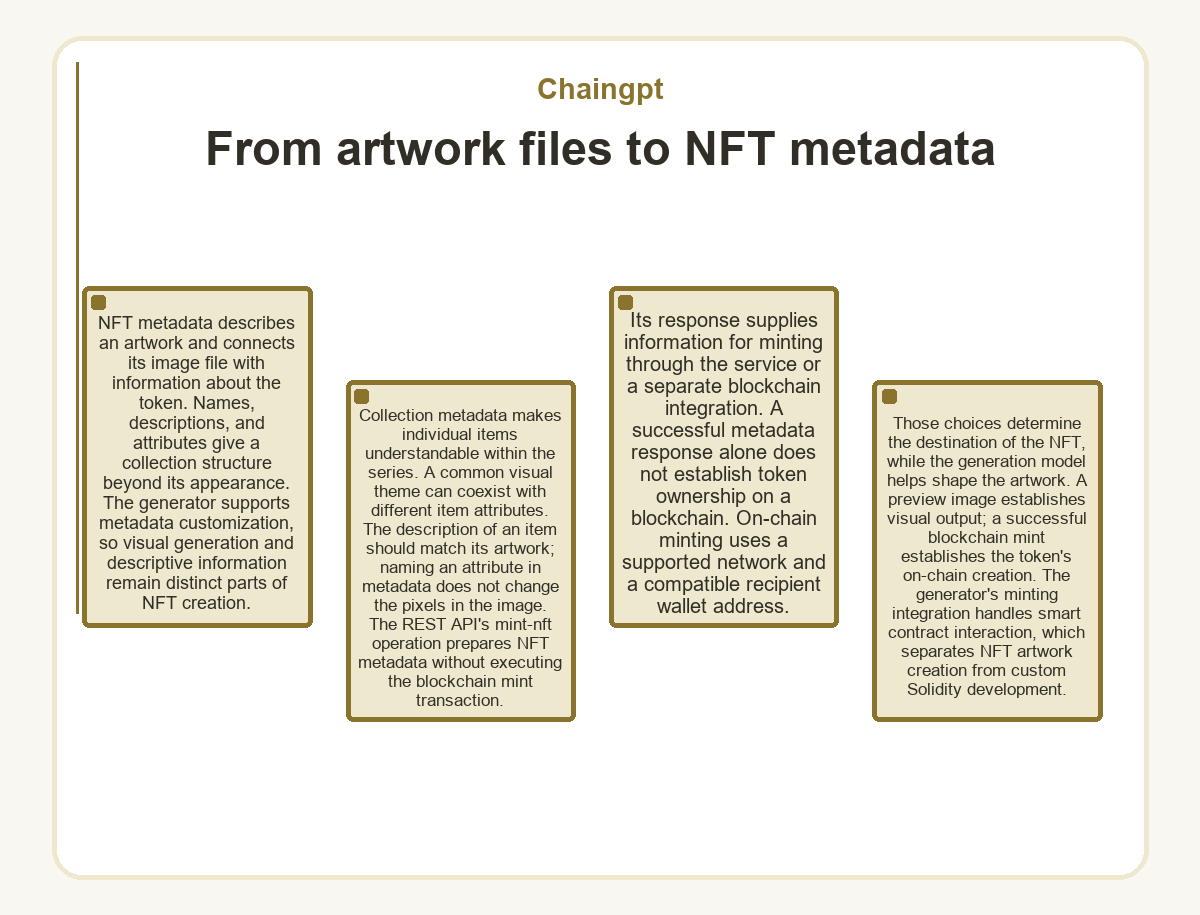
The REST API's mint-nft operation prepares NFT metadata without executing the blockchain mint transaction.
Its response supplies information for minting through the service or a separate blockchain integration. A successful metadata response alone does not establish token ownership on a blockchain.
On-chain minting uses a supported network and a compatible recipient wallet address. Those choices determine the destination of the NFT, while the generation model helps shape the artwork. A preview image establishes visual output; a successful blockchain mint establishes the token's on-chain creation.
The generator's minting integration handles smart contract interaction, which separates NFT artwork creation from custom Solidity development.
Can a style setting keep every character identical?
A style setting guides the artwork's aesthetic treatment; keeping a reference character's identity is the purpose of the separate character-preservation option. Shared style can make images look related without preserving every feature of the subject. Character consistency becomes a different requirement when the same recognizable subject needs to appear throughout a collection.
For supported image-to-image requests, the API's isCharacterPreserve option directs generation to retain the reference character's identity and features while applying the prompt. This option requires a reference image and incurs additional processing charges. It guides character preservation, without making a promise that every generated pixel will remain unchanged.
Individual compositions and collection-wide variation
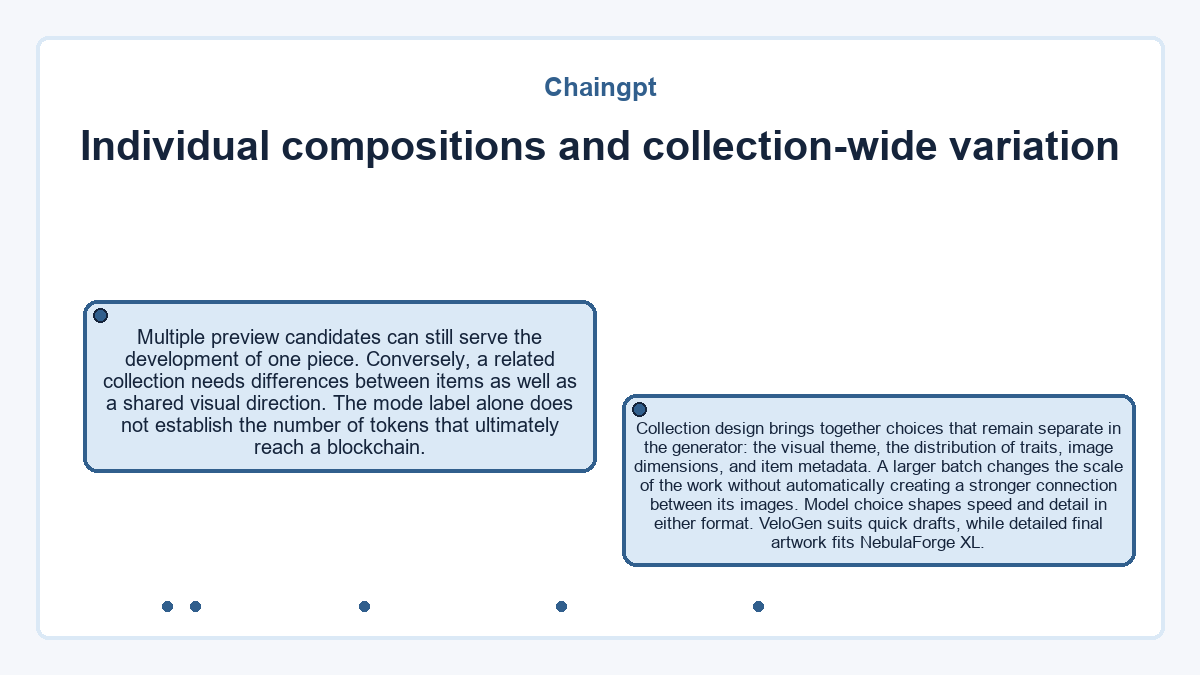
Multiple preview candidates can still serve the development of one piece. Conversely, a related collection needs differences between items as well as a shared visual direction. The mode label alone does not establish the number of tokens that ultimately reach a blockchain.
Collection design brings together choices that remain separate in the generator: the visual theme, the distribution of traits, image dimensions, and item metadata. A larger batch changes the scale of the work without automatically creating a stronger connection between its images.
Model choice shapes speed and detail in either format. VeloGen suits quick drafts, while detailed final artwork fits NebulaForge XL.
Chaingpt: quick answers
Does the NFT generator accept several different prompts in one API request?
The multiple-image API operation accepts an array of text prompts. This gives each requested composition its own description, while the request also carries generation settings such as the model and style. A shared collection prompt serves a different purpose by organizing related variations around common instructions. Several prompts in one generation request do not establish that any resulting artwork has been minted.
Why does a queued NFT request return a collection ID before any artwork?
A queued request returns a collection ID to identify an accepted generation job that continues processing in the background. The ID lets an integration retrieve progress and associate later results with that request. It does not indicate that the images are already ready or that a blockchain mint has completed. Image availability follows the generation job's status, while minting has its own completion condition.
Can I edit an NFT prompt without using paid prompt enhancement?
You can write or revise the text yourself and submit it for image generation without invoking the prompt-enhancement utility. Enhancement is an optional service that refines or expands the wording before the image model receives it. Manual editing avoids that separate utility charge. The generation request still follows its applicable credit or free-usage conditions.
Are NFTs made with older generation models still usable?
NFTs created with earlier text-to-image models remain functional after the upgrade to v3 generation models. The earlier text-to-image models are deprecated for new artwork generation. An older model's retirement therefore does not itself require regenerating the image or minting a replacement token.
Where can I list NFTs created with the generator?
The generator includes an integrated marketplace with OpenSea integration for listing minted NFTs. The marketplace also provides search, filtering, price history, and ownership information. Artwork generation, blockchain minting, and offering an item for sale describe different states. An image preview alone does not show that a token exists on-chain or that a marketplace listing is active.