 Chaingpt
Chaingpt smart contracts need security review before AI-generated code handles real assets
Chaingpt smart contracts require professional security review when AI-generated code will control real assets. The Smart Contract Generator turns written requirements into contract source code. Its Solidity workflow includes compilation and deployment to supported networks. The Smart Contract Auditor examines code for security weaknesses, logic errors, and gas inefficiencies. Generation provides a draft; an audit provides findings about the code that it examines. Neither output establishes that every important requirement works correctly. Before launch, the release decision must account for the contract's intended behavior, permissions, tests, and unresolved findings. An existing contract can enter the auditing path without starting again in the generator.
Updated ·
The short version: Security review must cover the exact contract code and configuration that a production deployment will use to manage assets.
New code or an existing contract
The starting material determines the appropriate tool: written requirements belong in the generator, while existing Solidity code belongs in the auditor. A generation request describes the behavior that the contract should implement. An audit request supplies the implementation that needs examination, alongside relevant questions about its behavior. Replacing an existing implementation with a fresh draft changes the code under review. That can introduce differences that an earlier report never examined.
A generated contract explanation helps someone understand the implementation, while a vulnerability report addresses potential defects.
Requirements and contract permissions
A useful contract specification describes permitted actions and the rules that those actions must preserve, including failures and administrative powers.
Behavior and invariants
An invariant is a property that must remain true across the contract's permitted operations. Balance accounting, supply constraints, and withdrawal restrictions can form part of those properties, depending on the application. The specification must express the intended rule before tests can challenge the implementation. A model cannot reliably choose an unstated business requirement simply from a recognizable contract type.
Source code is the human-readable program that defines those operations, and executable statements determine what the contract does. Comments and generated summaries explain its structure, so reviewers need the implementation alongside its description. The specification establishes what should happen; tests examine whether the code implements that rule. Relevant cases include permitted operations, rejected operations, and conditions that change eligibility. A withdrawal restriction needs tests for the affected paths, including any related permission changes. The rule should remain consistent wherever the contract allows access to the same balance.
Privileged actions
Access control determines which account or role may perform a restricted action. Specify who can change parameters, pause operations, mint tokens, or authorize upgrades whenever those features belong in the design. Extra administrative powers create additional trust assumptions, so permission checks must protect the affected operations. The deployment configuration must assign those permissions to the intended account or role.
Token rules and application logic
The generator covers standard token contracts and more specialized application logic. Their security requirements differ with the assets and rules that each implementation controls.
Fungible tokens
ERC-20 defines a shared interface for fungible tokens, including transfers and approvals for delegated spending. The generator supports ERC-20 and BEP-20 token designs. Supply policy, minting authority, transfer restrictions, and optional fees need explicit requirements. A familiar standard does not decide whether an administrator should hold those powers or whether a particular application needs them.
NFT contracts
ERC-721 contracts track ownership of distinct non-fungible tokens (NFTs). The generator supports NFT contract logic, including minting and metadata options. Artwork generation addresses the visual asset; the contract determines ownership and transfer rules. Review must cover the selected minting permissions and any privileged operation that can change the contract's behavior or metadata configuration.
Staking and vesting
Staking, vesting, and decentralized finance (DeFi) contracts introduce application-specific accounting. Reward rules and release conditions need their own tests. Generating a staking contract does not establish the terms of staking within the platform's separate ecosystem. Custom designs can span multiple contracts, so their combined permissions and interactions belong in the review scope.
Which language does the contract need?
The generator supports Solidity for Ethereum Virtual Machine (EVM) applications and lists Rust for Solana programs. Its EVM deployment options include Ethereum, BNB Chain, Arbitrum, Avalanche, and Berachain. Language support and interface support have separate scopes: the documented generator and auditor APIs focus on Solidity. A Rust generation option does not establish Rust support in that auditor API. The selected language, network, and interface must agree with the intended deployment environment.
Does compilation establish contract security?
Successful compilation establishes that a build satisfies the compiler's requirements; it does not prove that the contract behaves securely. The generator's built-in compiler checks the generated Solidity code and prepares bytecode, the instructions that the EVM executes. Compiler versions, imported dependencies, and build settings affect that output. Keep those inputs with the reviewed source so the deployment build can reproduce the relevant artifact. Compiler warnings also deserve examination, even when the build produces executable code.
Integration tests examine interactions between contract components. Unit tests examine individual functions, while property-based tests challenge specified rules across varied inputs. These methods address different questions from compilation. A successful transfer test cannot establish every permission boundary or accounting constraint. Testing needs expected behavior and failure conditions that match the specification, including the interactions that the application actually uses. Additional libraries and dependencies remain part of the executable system, even when the generator did not write them.
Quick audits and full audits
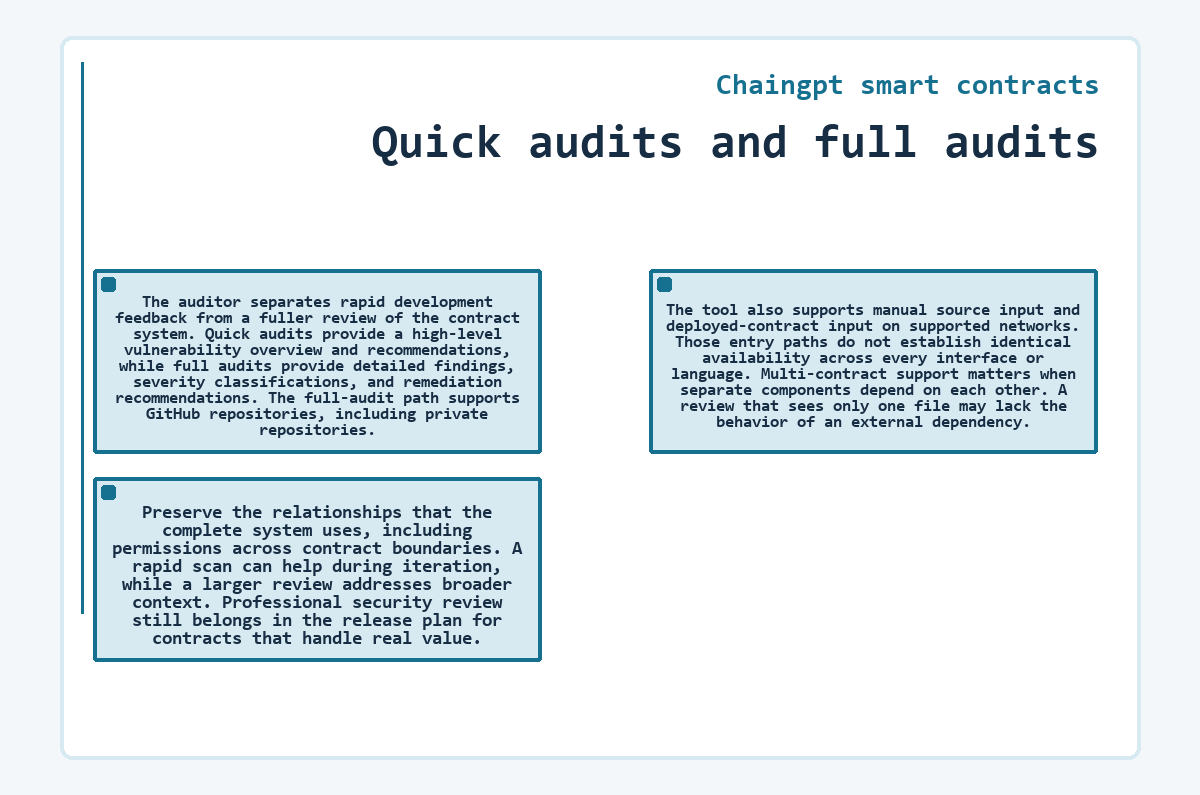
The auditor separates rapid development feedback from a fuller review of the contract system. Quick audits provide a high-level vulnerability overview and recommendations, while full audits provide detailed findings, severity classifications, and remediation recommendations. The full-audit path supports GitHub repositories, including private repositories. The tool also supports manual source input and deployed-contract input on supported networks. Those entry paths do not establish identical availability across every interface or language.
Multi-contract support matters when separate components depend on each other. A review that sees only one file may lack the behavior of an external dependency. Preserve the relationships that the complete system uses, including permissions across contract boundaries. A rapid scan can help during iteration, while a larger review addresses broader context. Professional security review still belongs in the release plan for contracts that handle real value.
How should a vulnerability finding guide a fix?
A useful finding identifies the affected code, explains the failure condition, and connects the recommended change to the intended behavior.
Reentrancy and external calls
Reentrancy can occur when an external call lets another contract enter the caller again before its earlier invocation finishes. The new call may observe balances or permissions before the first operation has finished updating them. The auditor identifies potential reentrancy weaknesses; reviewing the relevant call paths establishes whether a finding applies to the implementation.
The checks-effects-interactions pattern checks preconditions and updates internal state, the contract's stored data, before making external calls. Its suitability depends on the operations and dependencies involved. Review should account for related functions and contracts that share the affected state, since changing one function can affect their assumptions.
Permission and accounting findings
An access-control finding concerns the authority to perform an operation. A business-logic finding concerns whether the operation implements the intended rule. These can overlap when privileged actions alter accounting or release conditions. Severity helps prioritize investigation, while the explanation identifies the actual consequence. Gas optimization suggestions address execution efficiency and require the same attention to preserving behavior when code changes.
An audit score summarizes a report. It cannot establish an exploit probability or certify that the deployed system has no vulnerabilities.
Conditions for the release handoff
A generated Solidity contract can move toward deployment when its implementation matches the requirements and the review covers the intended release. The release handoff should carry the source, build settings, tests, and findings together.
- Continue with the build when the generated code implements the specified operations and permissions, with its dependencies available.
- Submit the actual release candidate for review, including related contracts that affect its behavior.
- Hold deployment if compilation fails, a required test fails, or a material vulnerability remains unresolved.
- After a correction, compile and test the changed code, then reassess the finding and any affected interactions.
- Hand off the reviewed version with its build configuration and resolved findings; check that deployment uses the corresponding artifact.
A successful AI response confirms that the service returned an answer. Deployment readiness requires evidence about the contract itself. If a fix changes permissions or accounting, an earlier report cannot establish the corrected behavior. The handoff is ready when the relevant tests, review conclusions, and build artifact refer to the same release candidate.
API access and request charges
API integrations require an account, a secret API key, and sufficient service credits. REST access and a Node.js software development kit (SDK) support automated generation or auditing. The generator and auditor API models each charge 1 service credit per request, rising to 2 credits when chat history is enabled. These request charges have a separate scope from web-plan terms and full-audit options. Blockchain deployment fees cover network activity; an AI request payment does not fund those transaction costs.
Professional review and changes after launch
Professional review examines the application-specific assumptions that a generated draft or automated finding may miss. The reviewer needs the intended permissions, accounting rules, dependencies, and deployment configuration. Keep review conclusions attached to the actual code version. A later functional change introduces a different implementation, even when most of the original source remains intact. Security review can therefore focus on both the change and its effects on the existing system.
Prompt content also needs deliberate limits. Contract behavior and relevant source code belong in the request. Wallet secrets, unrelated personal information, and live credentials do not help an auditor understand that behavior. In Solidity, marking a state variable private limits direct access within the program; it does not make on-chain information confidential.
Deployed EVM bytecode does not change simply because someone edits the source file. Any supported upgrade mechanism introduces its own permissions and operational constraints. A post-launch AI recommendation therefore needs an applicable implementation path and security review before it can affect the live application.
Manual development remains an alternative when precise implementation control outweighs the convenience of a generated draft. Reusable contract libraries provide a starting point for established patterns, and the open-source Solidity LLM offers a self-hosted generation option. These choices change how the implementation takes shape, while application-specific requirements, testing, and review determine whether it suits the intended deployment.
Things people ask
Can I edit generated code directly before sending it for review?
Yes, the generator allows direct code changes as well as AI-assisted revisions. An edited contract becomes the version that the reviewer must examine. Keep the revised source and its dependencies together, and retain the difference from the previous draft so the reviewer can understand which behavior changed.
Does a deployment transaction include the AI audit report?
A direct EVM contract-creation transaction carries deployment code and applicable constructor arguments, rather than automatically publishing the AI audit report. The report remains a separate review artifact. The reviewed source, build settings, and deployment configuration connect its findings to the contract instance that the transaction creates.
Will an audit of the original implementation cover a later proxy upgrade?
An earlier audit covers its reviewed implementation and scope, so a later proxy implementation needs assessment of the changed code. Review must consider upgrade authority, storage layout compatibility, and interactions with existing state. A proxy preserves a route to changing behavior; it does not extend an old report to every future implementation.
What values does the auditor API accept for the chatHistory setting?
The auditor API defines chatHistory as the string "on" or "off", rather than a Boolean value. Use the documented string when constructing the request. Enabling history retains conversation context and changes the request charge; omitting the setting uses the documented default of "off".
Where should an integration store its Smart Contract Auditor API key?
Keep the auditor API key in a secure backend environment, such as a secrets manager or an environment variable. Browser code and public repositories expose credentials to other people. A compromised key can authorize requests against the account, so revoke an exposed key and create a replacement.
How can an API integration separate discussions about different contracts?
A distinct sdkUniqueId separates history-enabled conversations by session or user. Reuse an identifier only for the discussion that should retain that context. The auditor's API documentation states that omitting the identifier makes history-enabled requests under the same API key share a global history.
Is a verified contract address equivalent to an audited contract?
Source-code verification establishes a relationship between published source and deployed bytecode; it does not establish that someone audited the code. An audit examines security within its stated scope. A source match helps connect that review to a deployment, while the findings and reviewed version establish what the audit actually assessed.
What does an HTTP 200 response establish during a streamed audit?
HTTP 200 indicates that the audit request succeeded and the service began streaming its response. It does not establish that the entire report has arrived. The integration must consume the stream through completion and handle errors or an interrupted connection before treating the response as a complete audit report.